San Junipero is a complex and extremely interesting episode. With themes of simulacrum and self presentation, it is sort of like the perfect capstone to this course. The easiest way to break this down would be to go in order of the class and start with self presentation.
In the episode, Yorkie meets Kelly in a club and the two form a connection. It seems like a normal night in a party town, except that the party seems to end, at least for Yorkie and Kelly, at exactly midnight. Later, we find out that both Yorkie and Kelly are actually elderly women reliving their youth through a virtual afterlife system that they are both giving the trial run. Yorkie is a special case, because in the real world she is paralyzed and comatose, unable to speak. When she is in San Junipero, she is young and trying to be more open than she could be in life. She wears glasses that she doesn’t need because they make her feel good and she even struggles with her self presentation in one scene when she tries to pick an outfit to see Kelly. Much like the theories outlined in “Self Presentation” by Baumeister and “For the Love of Being Liked” by Feiler, Yorkie picked a look that she thought was more pleasing to others than her real look, a comatose elderly woman. Likewise, it seems that everyone in San Junipero decides to be their best-looking self. Even if it wasn’t the happiest time in their lives, they chose the most attractive part.
The grander theme of the episode, however, is the real vs the simulacrum. On one side, you have Yorkie, a woman paralyzed at 21 who never had the chance to live a full life. She is delighted by the pleasures of San Junipero and when she finally passes over completely she is more effervescent and ecstatic than at any other moment. On the other side, there is Kelly. She enjoys her time in San Junipero, but she doesn’t completely buy into it. She is biding her time, waiting for her real self to die. When that happens she plans to just die. She doesn’t even believe in heaven, she just knows that whatever happens after death will be real. And she wants to die the way her husband and daughter did. However, in the end the excited Yorkie convinces Kelly to live with her in paradise. Their happiness seems real. Their new lives seem real. That begs the question, however, does that make it real? As Baudrillard says in the article on simulacrum, “in the third order of simulacra, which is associated with the postmodern age, we are confronted with a precession of simulacra; that is, the representation precedes and determines the real. There is no longer any distinction between reality and its representation; there is only the simulacrum”
San Junipero is an incredibly thought-provoking episode. It is a great summation to the course because it touches on so multiple of the themes we’ve been working on throughout the semester. It is also definitely one of my favorites in line with “Nosedive”.
Discussion Questions
Would San Junipero be considered real? Does something feeling and looking real make it real? In the internet age where television, movies and social media all get closer and closer to real life, does it matter anymore whether something is rooted in the real world?
How does this episode address the issues surrounding euthanasia? Does it handle it well? Or does it pose a good argument for or against it?
Introduction to Jean Baudrillard Part I: Postmodernity, Purdue. edu.
This article introduces the reader to the basic ideas of Jean Baudrillard and postmodernity. It begins with a short introduction to Baudrillard’s main ideas of nihilism and melancholia and his outlook on society. Then it goes through the finer points that Baudrillard talks about: the loss of history, mediatization, the proliferation of kitsch, consumer society, the “cool smile” and simulacra. The loss of history is self explanatory, but it is a symptom of mediatization, which refers to the media taking history and making it a “retro” simulation of itself. The proliferation of the kitsch is about society’s increasing affection for “trashy” culture, which is a part of consumer society. The “cool smile” is the self-aware elements of culture, which makes fun of itself, but solves no issue. Finally, the simulacra refers to the recreation of real things, without being fully real.
Introduction to Jean BaudrillardPart II: Simulacra, Purdue.edu.
In this article, the author goes more in depth on the ideas of the simulacrum and simulation: the false recreation of the real. It discusses Baudrillard’s ideas of media culture, exchange value, multi-national capitalism, urbanization and language and ideology. Media culture is the culture surrounding media consumerism, making even people commercialized. Exchange-value is a marxist idea which states that things stop being measured by the value of their use, but rather by what they can get us. Multinational capitalism revolves around the idea that we are losing touch with the reality of goods and services and everything becomes consumption. Urbanization is the idea that the more we modernize, we are losing touch with the natural world. Finally, language and ideology is about us losing touch with our reality through the ways we speak.
Annika Blau, Social Media and the Hyperreal, Medium.
In this article, Annika Blau discusses Baudrillard and social media. She starts by comparing high order simulacra, such as reality TV or porn, which dictate the norms they are supposed to be depicting, to lower order simulacra like the difference between seeing Timesn Square online versus in person. Then she discusses social media and it has become the highest form of social media. She does this by talking about “gramophiles” and their behaviors. For instance, she talks about the act of capturing food in a photo before eating it, which adds an extra layer to the eating experience. She finishes the article by posing a question: “Do we lose something in bashing through crowds to snap the Eiffel tower at the “right” angle rather than just being in its presence, in that moment? Do we lose something meaningful in having drinks with girlfriends if everyone’s too busy facebooking, tweeting and instagraming it to just be present in the moment?” I think the answer is both yes and no. We lose some bit of reality when we take every moment to be a photo op, but it is also so inundated into our culture that you barely even notice, and maybe that is even worse.
Jo Bell, How the internet is changing the way we grieve, The Conversation
The last article is much more on the nose for this week. Social media grieving is something very common in an internet culture, like the article itself states. The idea of going on Facebook or Instagram to express your grief is very real and very silly looking from the outside. To share a bit of personal experience, when my grandmother died, my aunt and uncle wanted to keep her Facebook alive and even wanted to post on it. I never found it very comforting and even wanted to delete it. My mother was on my side. Eventually, they compromised and archived the account, but it was strange to see everyone pretending to talk to her so publicly. The article discusses the idea and how keeping the dead alive on social media is so much different than the photographs and memories left behind in the real world.
Black Mirror: Be Right Back
In the episode Be Right Back, Martha Powell loses her husband, Ash, and is left feeling empty. Then she finds out about a program that allows you to talk to the dead by using their old social media profiles and emails. When she finds out that she is pregnant, she begins talking to Ash again, but things get more and more unsettling the deeper she gets into it. This episode explores themes of grief and mourning, as well as technology surrounding death and social media. The idea that software could use social media to recreate the identity of a dead person is not that far off. But it begs the question, is it good enough? Martha, apparently, does not think so, but she is also can’t bear to part with him. At the end of the episode we discover that years later, Martha has kept robot Ash in the attic of their home, unable to look at him, but unable to throw him away. The themes here are clear. It touches on Baudrillard’s theories of the simulacra and the imitation of the real very closely. This episode also ponders questions of authenticity and social media mourning, as brought up in the articles by Annika Blau and Jo Bell. In Sherry Tuckle’s article “Alone Together: Why We Expect More From Technology and Less From Each Other”, she discusses the idea of intimacy with robots, and whether or not there is a discernable difference. She does this by telling a few anecdotes, but the one that stood out to me was the story of her daughter in the museum. Her daughter wished they had used robot turtles in an exhibit about the Galapagos instead of the real ones so that they could be free. Tuckle was shocked at how little she cared about the authenticity of the turtles. This episode begs that very same question: Do we still care about authenticity?
Discussion Questions
In an increasingly advanced and internet based culture, does authenticity really matter? Is face-to-face even worth it with more convenient options like Zoom or Social Media? Should we still care about preserving those pieces of reality in our lives or are they becoming obsolete?
Is Social Media mourning real or performative? Does it matter? Is the performance of an action or emotion strike as true as the reality of it or is our culture so inundated with Social Media that it no longer matters?
I think that addicted is a strong word in general. I use my phone a lot, but if I wanted to I could go without it for a time. When I was a sophomore in high school, I dropped my phone into the ocean and it was swept away by the tide. However, I was on a school trip and my parents weren’t there, so I spent the rest of the trip without a phone. As far as I can remember, it didn’t change my state of mind at all. Social media on the other hand is a bit more addictive. Specifically, I find it hard to keep my mind off of responding to people as soon as they message me. I can be a bit obsessive about responding in a timely manner.
2. The three primary benefits I get from using my phone are pretty simple. First and foremost, its a way to stay connected to people I care about from far away. This kind of rapid communication is key to a busy social life. Secondly, there is an entertainment value I get from my phone. Be it social media, games or mobile streaming my phone always gives me something to do. You could argue that this has led to a constant need to be doing something, but all in all it’s fine. Finally, my phone allows me to take work with me anywhere. This is only really useful in college, but it helps to be able to email professors or attend class from anywhere.
3. In all honesty, I don’t know that there are three negative effects I could come up with. As I mentioned earlier, I think my phone has given me the need to constantly be doing something, whether I’m scrolling through social media or playing games. Aside from that, it may have decreased my attention span. I frequently get distracted by my phone and struggle to hold my attention on something else. Other than those two, however, I can’t seem to think of a third thing.
My most recent post on Instagram received only 41 likes, which is relatively low for me, but this was most disappointing because the post was about women’s rights, so for that to be lower than the others was sort of disappointing. My other two posts had just under 100 likes. One was a post for my birthday and the other was for my cat that had died. I didn’t feel any strong emotions related to these posts. I don’t get any real excitement from likes and only get disappointed if they are exceedingly low. It’s sort of a lose-lose situation, because high amounts of likes don’t thrill me, but low ones do hurt. That’s why I don’t really post on Instagram very often.
Overall, tracking my usage was sort of exactly as expected. I track my usage pretty often as it is, so this assignment was par for the course for me. I don’t really think I fall at either of the extremes. I am not overly attached to my phone, but I am not completely detached from it either. I am simply a phone user. I like my phone, and I wouldn’t choose to stop using it, but I could if I lost it or it broke. However, that being said, I don’t like not having it on me. That does start to make me a little nervous. So, maybe I am not objective enough to call out my usage.
I had the following conversation with my friend Amy on Wednesday at 2:37 P.M. with my phone on and Instagram open. It should be noted that before this assignment I had never heard of any of these brands except Domino’s which I have searched for before. I was going to switch it out, but my friends and I eat out a lot so there was fast food place I hadn’t looked up. I figured since all the other brands were so outside my wheelhouse, I would include this script anyways:
You: So I’m thinking of giving up meat
Friend: What? Why would you do such a thing?
You: The fresh salads at Squeeze Juicery and Core Life Eatery are enough to convert me.
Friend: But what will you do without your Domino’s sausage and pepperoni pizza?
You: I dunno, I just think I need more vitamins.
Friend: Couldn’t you just get tablets from GNC?
You: Sure but I prefer to get my vitamins from the Vitamin Shoppe.
Day Two: Thursday
For Thursday, I monitored both Instagram and Twitter for special advertisements. I did not see any advertisements for the brands I mentioned in my scripted conversation, however I did see a “Crest White Strip” ad on Instagram at around 7:30 P.M., which is interesting because my friends and I had spoken about it earlier in the day before dinner at 4:54 P.M. I didn’t see any ads on Twitter (which I don’t use often) so I figured that Twitter might not have ads. In the following days, I switched to Snapchat as my second social media app. Other Instagram ads I saw that had nothing to do with the script were an ad for Pen15, the Hulu show at 2:13 P.M., a Sony ad at 4:35 P.M. and an ad for something called “bestvideos” which I believe is some kind of app for book recommendations at 8:29 P.M.
Day Three: Friday
On Friday at 3:20 P.M. I had the following conversation with my friend Tyler. I would posit that I have never searched for any form of cheese, especially artificial, or air mattresses. I also have never been to or talked about Medina, New York.
You: I need to tell you something really important. I’m making a big life decision.
Friend: What is it?
You: I think I want to get rid of my old mattress and start sleeping on an air mattress.
Friend: Wow…that’s unbelievable. Any other important life changes?
You: Yes – I want to start eating more artificial cheese. String cheese. Spray cheese. Laughing Cow cheese! Give me more!… And I’d like to find a really great restaurant in Medina, NY!
Friend: I hear all of the great restaurants are in Medina, NY!
Day Four: Saturday
On Saturday, I checked Instagram and Snapchat for any notable ads. Interestingly, at 11:26 P.M., right after I woke up (classy right?) I saw an ad on Instagram for Vitamin Shoppe, which spooked me a little bit. After I started my day at 2:28 P.M., I saw an ad on Instagram for Laughing Cow cheese. Other than those two the only Snapchat ads I received were for teeth whitening, relaxation apps and weight loss techniques, which are pretty standard on Snapchat. On Instagram, I also saw another Sony ad at 5:57 P.M. and a Spotify ad at 9:04 P.M.
Day Five: Sunday
For Sunday, I followed my pattern and had the third recommended conversation with my friend Amy at 4:12 P.M. Like the other days, I had never searched for Niall Horan, One Direction, tickets to Ireland or stilletos.
Friend: What’s happening next month?
You: I’m going to a Niall Horan concert in Ireland
Friend: Niall Horan from One Direction?
You: I love him deeply, I just love Niall Horan!Friend: Have you got tickets to see him?
You: Nope, not yet. I need to find them cheap enough
Friend: Hmm… cheap tickets for Niall Horan in Ireland, that could be tricky!
You: And cheap stilettos
Friend: Yes. Well good luck with that, it sounds like you’ve got a lot going on.
Day Six: Monday
Unfortunately, I received no interesting ads on Monday. I checked both Instagram and Snapchat every couple of hours, but the only new Instagram ad was a Facebook ad at 10:37 P.M. and the regular Snapchat fare with the inclusion of a McDonald’s ad at 1:16 P.M. which promptly led to my friends and I going to McDonald’s for lunch. Other than that, I saw no ads in particular that might be related to my conversations. Not even a similar product from a different brand than those discussed.
Gaia Vince, Evolution explains why we act differently online, Mosaic/BBC.
In this article, Gaia Vince discusses several psychological studies into the idea of trolling. She starts by discussing the disproportionate amount of hate that is thrown at women and people of minority backgrounds and how the hate gets even worse at the intersection. To explore this phenomenon, Vince starts by discussing the “Greater Good Experiment” (which, side note, my friends and I have played as a game. I always won by having the most money for myself.) As the experiment goes, four people are given a set amount of money and asked how much they want to keep and how much goes into the collection box. Whatever money goes into the tax box is doubled and split among the four players. Some of the participants were asked to complete the task in 10 seconds, while others were given ample time to contemplate. Those who were asked to do it rapidly were more generous than those given time to consider. The experiment found that generosity was a component of human nature, since those without time to think were more generous. Then Vince went on to talk about the second trial, where participants were asked to just give away some of their money with no reward for themselves. The experiment found that those who were more generous in trial one were more generous in trial two and the same was true of those who were more selfish in trial one, who remained selfish in the second trial.
Vince’s conclusion from these studies is that people in their core are not cruel and our compulsion to help each other comes from the evolutionary basis behind working together to survive. However, the article concludes by saying that there is a troll in all of us, and that we need to continue to grow with social media to make it a more open and welcoming place.
Berit Brogaard, Should Hate Speech Be Free Speech? Psychology Today.
Berit Brogaard’s article is a fairly straightforward one. In it, she discusses freedom of speech and where hate speech falls in terms of protection. She begins by talking about the U.S.’s history of hate speech which has lead to physical violence, such as the case of Robert Bowers. She goes more in depth with a case about a gang of bike riding kids protesting the lack of affordable housing, which leads to a man named Mark Allen Bartlett pointing a gun at them and slinging racial slurs.
When it went to court, Bartlett tried to plead his first amendment rights, but the judges decides that his words were inciting physical action and are therefore not protected. Brogaard goes on to give a lesson in direct speech vs. indirect speech which, personally speaking, took up more of the article than it really needed to.
She concludes by posing the question, “So why don’t we simply conclude that hate speech is damaging, because it hurts people’s feelings?” (Brogaard 5). This is an interesting question, because what are the legal ramifications of hurting someone’s feelings? Should there be any? Personally, I’m not sure and it seems neither is Brogaard.
Elle Hunt, ’What law am I breaking?’ How a Facebook troll came undone, TheGuardian.
Elle Hunt’s article “‘What law am I breaking?’ How a Facebook troll came undone”, tells the story of a girl named Olivia Melville, who used a rap lyric in her Tinder bio and accidentally started a riot. After a man named Chris Hall posted her Tinder profile to Facebook with a sexist comment, Melville retaliated and started a war. One man, Zane Alchin, took the squabble to far and threatened rape and abuse to a woman defending Melville, Paloma Brierley Newton.
Newton reported his comments to the police, citing the harassment as rape threat. Alchin claimed that he was drunk and regretted the posts, but he was convicted. Not of threatening to rape the women, but of online harassment, as the judge thought that being miles apart and speaking over Facebook meant that no threat of rape could be taken seriously.
The most unsettling fact, however, is that some regard Alchin as a hero fighting the rising feminist regime. They call for him to be forgiven of all charges and believe that he was reacting as anyone should to “unhinged women”. Alchin has shown no sign of agreeing with these claims, but he has not publicly denounced them either.
Episode Analysis
In the episode “Hated in the Nation”, we follow a detective trying to solve the strange murders of several controversial celebrities. This episode is interesting, because it begins by investigating a school teacher who sent the first victim a threatening cake and seeds in the idea of the #Deathto hashtag. As it goes forward, it is revealed that it is the hashtag that is killing these people, unbeknownst to those posting it.
The themes of this episode are somewhat similar to “Shut Up and Dance”. People see something they don’t like and seek retribution through death threats and hate messages. This is in an attempt to seek some sort of justice. The trouble with online speech like that though, as we see through the teacher, is that people rarely actually mean it. Instead it’s some form of catharsis. They feel good about their moral position and resort to hate speech to feel even better. Normally, the only toll this would take is emotional, but in this episode it gets physical.
Eventually, it is revealed that the real target all along was the trolls who went after people like that. In the end of the episode, everyone who had ever used the #Deathto hashtag was killed by the hacker and he had made his point. In his game, there were consequences to speaking your mind in the Wild Wild West that is Twitter.
Discussion Questions
How much blame is to be put on people who used the #Deathto hashtag before they knew it actually led to death? Is it morally wrong to wish death like that on the internet or did it only become wrong when the death game was publicly revealed? Furthermore, is it wrong to seek retribution through the #Deathto game? Are the posters at fault or does the blame lie solely on the murderer?
Is seeking catharsis from death threats morally grounded? Even if you wish no death on the person you’re attacking, is it still okay to wish death on someone to make yourself feel better?
Kim Zetter, Cyberbullying Suicide Stokes The Internet Fury Machine, Wired.
This article discussed the controversy surrounding the suicide of Megan Meier. Meier was a 13 year old girl from Missouri and was driven to suicide after a cyber bullying incident involving another student’s mother.
Lori Drew was the mother of one of Megan’s friends, and in an attempt to find out what Meier truly thought of her daughter, Lori posed as a cute boy who was interested in Megan, only to end the relationship and bully Meier, which led to the young girls suicide.
Sarah Wells, a blogger, found out about this situation and exposed the mother’s name when newspapers refused to. This lead to an Internet outrage against Lori Drew. The situation was only made worse when Lori sued Meier’s father when he damaged her property out of rage and grief.
Eventually, the internet turned on Wells for going after Lori so publicly, and her information was found out and posted on the internet as well.
Cyber Vigilantes: Do-it-Yourself Justice Online, NPR.
In this radio broadcast, Neal Conan talked to multiple people about cyber vigilantism and it’s merits, consequences and drawbacks.
First he spoke to blogger Sarah Wells about the issues addressed in the previously mentioned article. In this broadcast, however, we got to hear from Wells herself.
The most interesting part of the conversation was when a caller came on and asked about how Wells felt about her possible negative impact on the health and safety of Lori Drew. Wells responded by saying that she felt bad if anyone who cared for or knew Lori was negatively affected, but felt that Lori deserved what she got.
After the Wells conversation, Conan moved on to a conversation with Professor Solove about the legality and morality of cyber vigilantism.
The broadcast concludes with a caller named Brandon who shares his personal experience with so-called “cyber vigilantism” and what the consequences can be for the other side.
Alexander Abad-Santos, Inside the Anonymous Hacking File on the Steubenville ‘Rape Crew’. The Atlantic.
This article looked into the Steubenville “Rape Crew” incident, and the involvement of an anonymous hacker group in the case.
When a 16 year old girl from Steubenville, Ohio was “allegedly” raped by two football players from her high school, the case was a confusing jumble of they said/she said. However, when a hacker group called Anonymous found and leaked evidence of the rape, things became a lot more concrete.
In particular, a video of some friends of the rapists was leaked, where the two boys said such awful things as “she is so dead right now” and “they raped her more than the Duke lacrosse team”. This video, piled on top of plenty of other evidence, was leaked by Anonymous which led to the case became a maelstrom of conflicting arguments.
The “Rape Crew’s” football coach, Reno Saccoccia, was criticized for his response and dealt with press very aggressively and threateningly.
Episode Analysis
“Shut Up and Dance” seems at first to be an episode about an insecure teen worried about being made fun of for being seen by his peers in an… intimate moment. However, it quickly turns into a chilling tale of cyber-vigilantism and pedophilia.
The hackers in the episode represent cyber-vigilantes. They take the dark, disgusting secrets of people and expose them for all to see. Of course, this isn’t without a little torture first. Meanwhile, our “hero” is a scared kid that one can hardly help but root for. Even after you find out his deep dark secret, it’s hard not to feel something as he sobs on the phone with his screaming mother.
The struggle of the episode is whether or not this is a deserved punishment. The main character may be a pedophile, which, obviously, is not acceptable, but does he deserve to be so heinously tortured. He may be supporting child pornography by looking at it online, but is putting him through such damaging psychological harm worth it? Some may say yes, others might say no. This is the main argument of cyber-vigilantism. It deals with the most egregious traits of humanity, racism, homophobia, pedophilia, etc. but the psychological toll may be too steep for any crime. The other point is the severity of the crime. Some victims of cyber-vigilantism can be punished severely for small crimes, like “poop girl” who left her dog’s poop on a subway.
Discussion Questions
In an Internet culture where your online identity can be a huge part of who you are and how your viewed, is tarnishing that online reputation a fitting punishment for any crime?
Does the blame fall on the perpetrator or the vigilante if any harm befalls the “guilty” party?
Black Mirror since its beginning has been a show that pushes boundaries, and the first episode pulled no punches. The episode tells the story of Prime Minister of a fictional United Kingdom named Michael Callow. In the episode, the nation’s most beloved princess, Susannah, Duchess of Beaumont, is kidnapped and held for ransom. The ransom, however, is not money, but an odd request. The kidnapper demands that the Prime Minister go on live broadcast and have sex with a pig. At the start, Callow and his team do everything in their power to avoid this broadcast. They try to track down the princess and even fake a broadcast. However, nothing works and Callow is eventually forced to film the broadcast. The twist, however, is that the kidnapper releases the princess thirty minutes before the broadcast. No one notices though, because they are all tuned in to gleefully watch the Prime Ministers humilation.
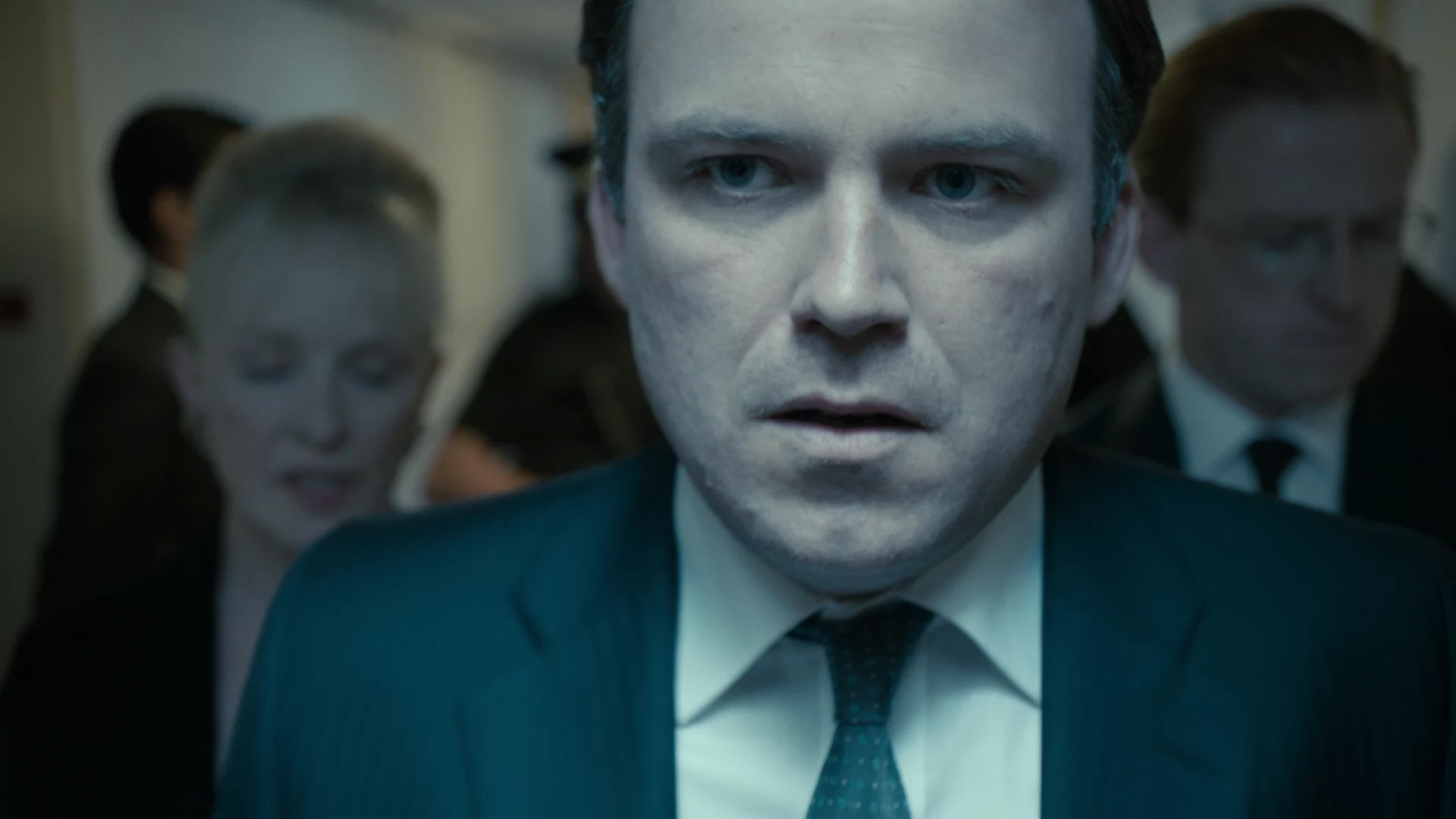
Prime Minister Callow finding out that Princess Susannah has been kidnapped. Source: Netflix
There are two main themes of the episode: the sway of public opinion and the willingness of the public to enjoy the humiliation of others. The first is simpler. In the beginning of the episode, we are explicitly told that the public opinion is that Callow has no responsibility to film this broadcast. However, after one of his advisors tries to create a fake broadcast and the kidnapper retaliates by “cutting off her finger” (which turns out to be his own), the public opinion changes. After watching the princess suffer, suddenly it becomes Callow’s duty to rescue her, no matter the cost. This is an extreme example, obviously, but it isn’t so far from the truth. Callow is ultimately forced against his will to make the broadcast. The scene is harrowing, as you watch Callow lose a piece of himself in front of the nation. This can be the power of popular opinion, especially in politics. As the article, “How social media gives public opinion wings”, says, “Instant feedback increases the potential of both the candidate’s responsiveness and accountability to the public. Because candidates are able to watch public opinion shift quickly, one would think they would simply adjust their stances in accordance with those changes and flip-flop on issues.” This is a more realistic example of how public opinion in the modern day can have a huge effect on politicians.
Callow on his way to film the broadcast. Source: Netflix
The second, and in my opinion more important, theme is that of humiliation. The message the kidnapper was trying to send. As stated earlier, the princess was released before the broadcast ever happened, but no one noticed because everyone was glued to their televisions, watching their Prime Minister have sex with a pig. The kidnapper knew this and it was his point entirely. He was sending a message about people, and our willingness to bear witness to other people’s lowest moments. In the article, “The secret joys of schadenfreude” there is a line that sums this up perfectly, “Schadenfreude may appear antisocial. Yet it is a feature of many of our most cherished communal rituals, from sports to gossip.” This is exactly what we see in the episode. People gather in groups to watch it. They have it on at bars, nurses gather to watch it at work, people are treating it like a sports game. Multiple times characters say that it’s “history we’re watching”. It’s unsettling to watch, mostly because it is not inaccurate. If this was to happen today, the same thing would probably happen. People would flock together to enjoy Trump’s humiliation the same way they did Callow’s, if not even more viciously. In fact, political leanings are barely mentioned in the episode, but certainly in today’s society political divisions are so deep that there would be millions of people who would love to see Trump or Biden in such a position.
“The National Anthem” is a twisted episode for Black Mirror to start with, for sure, but it isn’t without reason. The episode is full of themes that are extremely relevant to society today. Black Mirror is not only a show that pushes boundaries, but a show that should be watched extremely closely.
Donnie Darko directed by Richard Kelly is by far one of the most mind-bending films ever made. Of course, the nature of a mind-bending film entails that it is also post modern in many ways.
Donnie Darko looking all spooky scary sexy
Donnie Darko himself is a ill defined character. He is a allegedly mentally ill teen boy who has visions of a rabbit warning him of the end of the world. The other people of the film world describe him as a paranoid schizophrenic, but Donnie believes his visions to be a specific type of time travel that allows Frank to warn him of the world ending. To this end, Donnie does some bad things at Frank’s command. He floods his school and burns down the house of local author Jim Cunningham. It would be hard, however, to call Donnie a bad person, because he truly believes that he has to do these things to repay Frank for saving him from the mysterious jet engine. We also get to see things from Donnie’s skewed perspective and it is obvious that the world he is living in is incredibly scary. He sees things that no one else can see and everyone around him calls him crazy. It is obvious why it wouldn’t be the easiest life to cope with.
R.I.P. Gretchen… or not?
The ending of Donnie Darko is even more mysterious than the lead character. After spending the whole movie with Donnie as he tries desperately to figure out how the world is going to end and what he is really seeing, we finally get to the end. Gretchen is run over by present Frank, Donnie shoots him in the eye and we finally learn that the engine that almost killed Donnie actually came from the plane his mother and sister are riding in. Donnie laughs a little maniacally as he watches his world crumble and then we cut to all our favorite characters waking, as if from a nightmare, and looking dazedly around their rooms. Donnie continues to laugh, now in bed, as the jet engine falls into his room killing him. Suddenly, we’re at the beginning of the movie once again with no explanation as to what really happened. Gretchen and Donnie never met, the jet engine still came from nowhere and every character seems to have experienced the same nightmare. What this all means is beyond explanation, at least in under 5000 words, but this ending definitely qualifies as “without conclusion”
Taxi Driver by Martin Scorsese is a quintessential postmodern film. There are many characteristics of postmodern film, and Taxi Driver is a perfect example of two of them specifically.
Travis in the start of the film, driving his cab.
Firstly, we have Travis Bickle, our favorite New York cabbie, who is a perfect example of a character without clear definition. He not only changes rapidly throughout the movie with no clear path of development, as he becomes less and less attached to reality. Even more unclear is his “alignment”. Many of his actions are chaotic or even illegal and he seems hateful and spiteful towards the people of New York City. However, the reason for his spite is because he believes that the city could be better. On the other hand, he resorts to violence to achieve this and it is implied he is racist on top of a violent gun owner. In the end he does “save” prostitute Iris and return her to her family, but only by brutally murdering everyone in the house. After this, however, he is hailed as a hero and even seems to get some redemption in the eyes of Betsy. So, needless to say, his character is clearly as undefined as the come.
Travis later in the film, clearly detached from reality at this point
Not only that, but Taxi Driver has an odd method of story telling and an ending without closure. The story begins with Travis as a regular taxi driver and establishes his issue sleeping and his troubling views of New York. However, Betsy is introduced out of nowhere, but then not seen again until later when suddenly they begin dating. The expectation becomes that this movie is to become a romance. Then, Betsy breaks it off. Now the movie turns darker as Travis begins getting weapons and falling into madness so you think, “Oh golly, he’s gonna kill Betsy,” but he doesn’t. Instead he starts to target politician Charles Palantine. So, then it becomes an assassination thriller. At some point Iris is randomly introduced in a chilling scene. The only tip that this is important is the twenty dollar bill that her pimp gave Travis. Then an act later, suddenly Travis is unconcerned with the politician and wants to save Iris. The climax comes as Travis destroys the pimps and you think the movie is over, but instead we see Travis as a hero, for saving Iris, and into his taxi comes Betsy. He drops her off and the movie ends, just like that. No conclusion, no idea what becomes of Travis, no idea if Betsy gets back together with him. The only conclusion we get is that of Iris, who is back with her family, but we don’t know if she’s happy there since she ran away in the first place and she seemed pretty emotionally traumatized when Travis burst in and killed everyone.
Taxi Driver is certainly an experience and like a postmodern film I have no conclusion for this blog post.
The Fifth Element by Luc Besson is a french science fiction film that follows Korben Dallas, a New York cab driver in the distant future, who finds Leeloo. Leeloo is the embodiment of the “fifth element” and the perfect human and it’s up to her to bring all five together to prevent an ancient evil from devouring all of humanity. So, Korben and Leeloo must find the other four elements and survive the onslaught of disposable baddies in order to save the world and after some hilarious and thrilling misadventures through space, they finally do.
There are many different genres that go into The Fifth Element. The first and most obvious is science fiction. The Fifth Element draws from many of the great aspects of science fiction. It includes space travel, futuristic settings and battles with an “other” or alien race. The Mangalore baddies throughout the film echo the traditions of many sci-fi movies. They are faceless inhumans that scare just as well as they die.
The Mangalores! Source: Davis, Deborah. “Cinema’s Greatest & Ugliest Visiting Alien Creatures: The Fifth …: The Fifth Element in 2019: Fifth Element Aliens, Fifth Element, About Time Movie.” Pinterest, 25 Jan. 2019, http://www.pinterest.com/pin/466685580112944567/.
We also have elements of the space opera, as immortalized in classics such as Star Wars by George Lucas. The relationship between Leeloo and Korben blossoms into a romance for the ages, there are fights set to alien operatic vocals by none other than the director’s wife, with the help of a computer of course, laughs and character arcs that bring us through the journey. These are all characteristics of operatic story telling, but to top it all off they are in space!
The diva Plavalguna. From the background it is shown they are in space. Source: “Mondoshawan.” Alien Species, aliens.fandom.com/wiki/Mondoshawan.
Narrative Structural Analysis
Without a doubt, The Fifth Element follows the traditional three-act structure seen in many films. We have a clear set up and a rather lengthy one at that. We start out with an alien race descending on an ancient Egyptian archaeological endeavor and unlocking a tomb within the pyramid. This establishes part one of our main conflict, the McGuffin. Aliens have something valuable and are hiding it from someone or something and this object is supposedly powerful.
The Mondoshawans at the start of the film. Source: “Mondoshawan.” Alien Species, aliens.fandom.com/wiki/Mondoshawan.
Our conflict part two is introduced with the ancient evil, a gigantic ball of black fire careening towards Earth ready to destroy all of humanity. The only thing that can stop it, well wouldn’t you know, would be the very objects our first aliens were hiding. The first aliens return to Earth to get their magic rocks, but they are destroyed by Mangalores, evil aliens hired by the great evil’s minion Zorg, and the stones are lost. From a surviving limb of one of the Mondoshawans, the good aliens, Leeloo is created by scientists. She meets Korben Dallas, a special forces major turned taxi driver and she guides him on an adventure to find the stones.
This leads to Act 2 which kicks off with Korben and Leeloo hopping on a luxury cruise because apparently the stones are with an opera singer performing aboard the ship. Korben goes to the opera, Leeloo kicks some Mangalore butt and the stones are retrieved in a fiery battle. In our climax Leeloo, Korben and Ruby Rhod attempt to use the stones to destroy the ancient evil and Act 3 closes with Leeloo and Korben falling madly in love and we get our happily ever after.
The happily ever after. Source: Mearse, Heather. “5the Element … the Kiss That Saved the World!: Makes Me Smile in 2019: The Fifth Element Movie, Movie Kisses, Kissing Scenes.” Pinterest, 21 Feb. 2019, http://www.pinterest.com/pin/110127153359073785/.
All three acts of the classic three act structure are clearly visible throughout the story of The Fifth Element. The set up of the characters and conflicts in the beginning, the rising action on the cruise ship and finally a tender embrace after the ancient evil has finally been disposed of.
Mise en Scene
Every scene in The Fifth Element is meticulously designed. The backgrounds are thematic and every extra has a reason to be in the shot. A viewer gets a lot out of every scene and it’s easy to pluck one scene out of the film and still be able to see some of the integral parts of the film.
Korben and Leeloo at the boarding station. Source: “Out After Midnight Series Presents ‘The Fifth Element’.” Rome Daily Sentinel, 24 Aug. 2017, romesentinel.com/stories/out-after-midnight-series-presents-the-fifth-element,15509.
Firstly, the scene where Korben and Leeloo go to the boarding station. In this scene, many things about the movie are clear even if you’ve never seen it before. You can see the Korben and Leeloo are our leading man and leading lady based on their social blocking. They also stand out because most of the extras are wearing black, but Korben and Leeloo both have orange as a signature color.
You can also tell that it is set in the future because of the set around them. The technology is advanced and in the back there are large piles of garbage which shows the advancement of pollution into the future
The concert of diva Plavalaguna. Source:Ebert, Dick. “The Fifth Element (1997) – The 80s & 90s Best Movies Podcast.” Shat The Movies Podcast, 8 Oct. 2019, shatthemovies.com/fifth-element-1997/.
The next scene to analyze is the concert of the diva Plavalaguna. This scene shows off another important component of the film. You can see from this scene that the characters are in space, because of the planet in the background. From this scene you can also see that there are aliens, but at this point they are socially accepted. These two things together can clue a viewer in to the fact that this is a space adventure movie rather than say an alien invasion film. The alien diva is a noted performer and a normal part of this intergalactic society.
Color
Color is an important aspect throughout the film, representative of the different forces working in the plot. Red seems to be a running color for many of the human elements. Bystanders and human structures are adorned in reds, whites or blacks. It is the backdrop that the more important characters and elements stand apart from. This can be seen in both the opera hall and in human cities, such as the giant McDonalds in New York. Ruby Rhod, who is the most “human” of the four main characters, wears red on top of the fact that his name is that of a red stone.
The blue diva with a blue planet lighting the scene. Source: “Mondoshawan.” Alien Species, aliens.fandom.com/wiki/Mondoshawan.
Blue seems to represent a middle ground. The flight attendants and other women that are human, but not quite bystanders, wear blue as their signature color. Zorg’s assistant is seen wearing blue, but has red nails that tie her to humanity, showing she isn’t actually apart of Zorg’s plans. The one clear exception to this is Plavalaguna. Blue is clearly her signature color. Not only is her skin and dress blue, but also the veil she wears when she is introduced and even her blood are shown to be blue. This represents her connection to both humanity and the Mondoshawans as she is entrusted with the stones after they are retrieved from earth.
Leeloo with her orange hair, wearing orange, lit in orange. Source: Fawcett, Kirstin. “The Fifth Element Is Coming Back to Theaters.” ‘The Fifth Element’ Is Coming Back to Theaters | Mental Floss, 7 Apr. 2017, mentalfloss.com/article/94135/fifth-element-coming-back-theaters.
The most notable color is orange. Korben wears some orange, but more than anything it is Leeloo’s signature color. Orange is tied to human red as the two are analogous colors, but it separates Leeloo as the perfect being and notes her importance to the defeat of the ancient evil. It is also complementary to the blue of the diva, which shows that Leeloo is one of two worlds, the alien fight to save humanity and humanity itself.
The Fifth Element is shot like many other action films. It is well lit with wide shots to show all the fighting going on. During the romantic scenes the camera is close to show a budding love and in space you can see a whole spaceship. There aren’t many shadows as to show the world the director is trying to build for the story. The lighting is high key and the main focus is usually the characters acting in the scene.
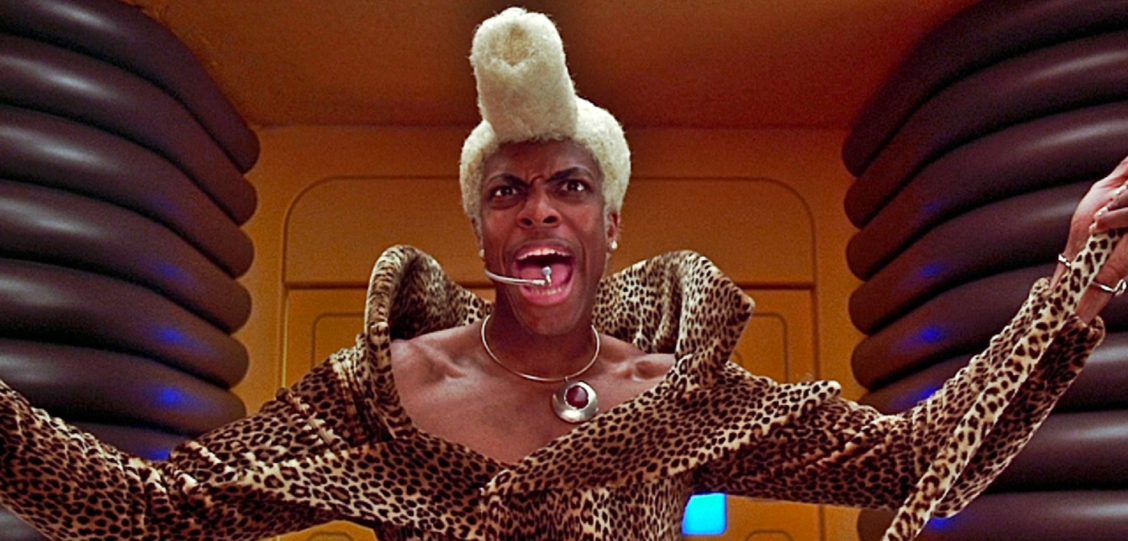
Other times, the cinematography seems to put the audience into the movie, making them a character. A good example is Ruby Rhod’s introduction, where he gets right up close to the camera like he’s getting in your face. It shows the kind of character he is while also displaying why his over the top personality might be obnoxious.
Editing
As far as montage goes, the one that appears most in The Fifth Element is easily rhythmic. Whether it’s a fighting scene with rapid cuts or something more choreographed, rhythmic montage is everywhere in this film.
One example would be when the ship to Fhloston Paradise is taking off and we cut between the pilots preparing, Vito Cornelius attempting to find his way onto the ship and Ruby engaging in off-screen activities with a flight attendant. As the plane gets nearer to taking off, these scenes become shorter and the cuts are more frequent, following the rhythm of the pilots preparations and finally concludes with the plane taking off in one long shot.
A flight attendant who is a part of Ruby’s off-screen activities…. Source: Noessel, Christopher. “The Fifth Element (1997) – Page 2 – Sci-Fi Interfaces.” Sci, 23 May 2013, scifiinterfaces.com/category/the-fifth-element-1997/page/2/.
Another example, and as some might say the best part of the entire film, is the concert. The concert begins as Plavalaguna sings a beautiful, slow aria in long takes that cut between her and the Mangalores entering the diva’s suite. The cuts are far apart and we get more of the performance than the other perspective. Then the song ends, but the montage doesn’t end there.
As Leeloo enters the suite in pursuit of the Mangalores, the diva begins a new, more upbeat song. The cuts back and forth become more frequent, following the faster rhythm of the new song. This sets the tone for the action as Leeloo fights off the Mangalores to protect the stones. As she defeats the last Mangalore, the diva finishes the concert, but still the montage isn’t over.
The final segment happens as the remaining Mangalores on the ship attack the concert hall and Zorg takes the stones from Leeloo. The diva is shot and Korben talks to her. As she gives him sage advice about the fragility of Leeloo, we cut back to Leeloo after she’s been shot by Zorg. The scene is heartbreaking as she lay dying and Korben has no idea. Plavalaguna then tells Korben where the stones are as we see Zorg open his case to see the stones aren’t even there.
The concert montage helps to set three different tones to the same scene as the rhythmic and tonal montage follows Plavalaguna’s song and afterwards her words. It wouldn’t be the same if the scenes had been separated. Apart they couldn’t have achieved the same tone.
Diegetic and Nondiegetic Sound
Lastly, there is sound. For this, the concert once again becomes important. In the aforementioned concert scene, we see the scene cut between Leeloo’s battle and Plavalaguna’s song. The song is both diegetic and nondiegetic, because the audience of the concert can hear the song, but Leeloo seems to be fighting to its rhythm even though she herself cannot hear it. As we watch Leeloo fight the Mangalores, the song is nondiegetic as it becomes part of the soundtrack for the fight. Interestingly, the song is also some of the only diegetic music, of importance to the characters anyway.
The diva performing her opera. Source: “Diva Plavalaguna.” Fifth Element Wiki, fifth-element.fandom.com/wiki/Diva_Plavalaguna.
A good example of pure nondiegetic sound would be “Ruby’s theme”, the music that plays every time Ruby is on air. The music does not seem to be apart of his show, rather the extra noise and punchy song seems to stress the energy of his show and the character himself. Ruby is loud and exuberant and the music blaring underneath his voice only displays that for the audience.
Ruby Rhod himself. Source: Mackie, Drew. “After 20 Years, Ruby Rhod Is Still the Best (and Queerest) Piece of ‘The Fifth Element’.” Hornet, 4 May 2017, hornet.com/stories/fifth-element-queer-ruby-rhod/.
Davis, Deborah. “Cinema’s Greatest & Ugliest Visiting Alien Creatures: The Fifth …: The Fifth Element in 2019: Fifth Element Aliens, Fifth Element, About Time Movie.” Pinterest, 25 Jan. 2019, http://www.pinterest.com/pin/466685580112944567/.
“Diva Plavalaguna.” Fifth Element Wiki, fifth-element.fandom.com/wiki/Diva_Plavalaguna.
Ebert, Dick. “The Fifth Element (1997) – The 80s & 90s Best Movies Podcast.” Shat The Movies Podcast, 8 Oct. 2019, shatthemovies.com/fifth-element-1997/.
Fawcett, Kirstin. “The Fifth Element Is Coming Back to Theaters.” ‘The Fifth Element’ Is Coming Back to Theaters | Mental Floss, 7 Apr. 2017, mentalfloss.com/article/94135/fifth-element-coming-back-theaters.
Mackie, Drew. “After 20 Years, Ruby Rhod Is Still the Best (and Queerest) Piece of ‘The Fifth Element’.” Hornet, 4 May 2017, hornet.com/stories/fifth-element-queer-ruby-rhod/.
Mearse, Heather. “5the Element … the Kiss That Saved the World!: Makes Me Smile in 2019: The Fifth Element Movie, Movie Kisses, Kissing Scenes.” Pinterest, 21 Feb. 2019, http://www.pinterest.com/pin/110127153359073785/.
Noessel, Christopher. “The Fifth Element (1997) – Page 2 – Sci-Fi Interfaces.” Sci, 23 May 2013, scifiinterfaces.com/category/the-fifth-element-1997/page/2/.
“Out After Midnight Series Presents ‘The Fifth Element’.” Rome Daily Sentinel, 24 Aug. 2017, romesentinel.com/stories/out-after-midnight-series-presents-the-fifth-element,15509.




 Spilling the Tea